Mahjong Builders
This is the real table game — the one with racks, a wall, and four seats — shrunk down to kid size. It's Asian mahjong (the Guangdong game), played with the exact same tiles as the grown-ups' Mahjong Mafia app. Five little games teach the skills one at a time: name the tiles, finish the sets, build a small hand, spot the winning tile, and take real turns — draw one, throw one. Every game is broken into Easy, Tricky and Expert levels, and hands grow from just 5 tiles all the way to full size, the same way real mahjong teachers do it.
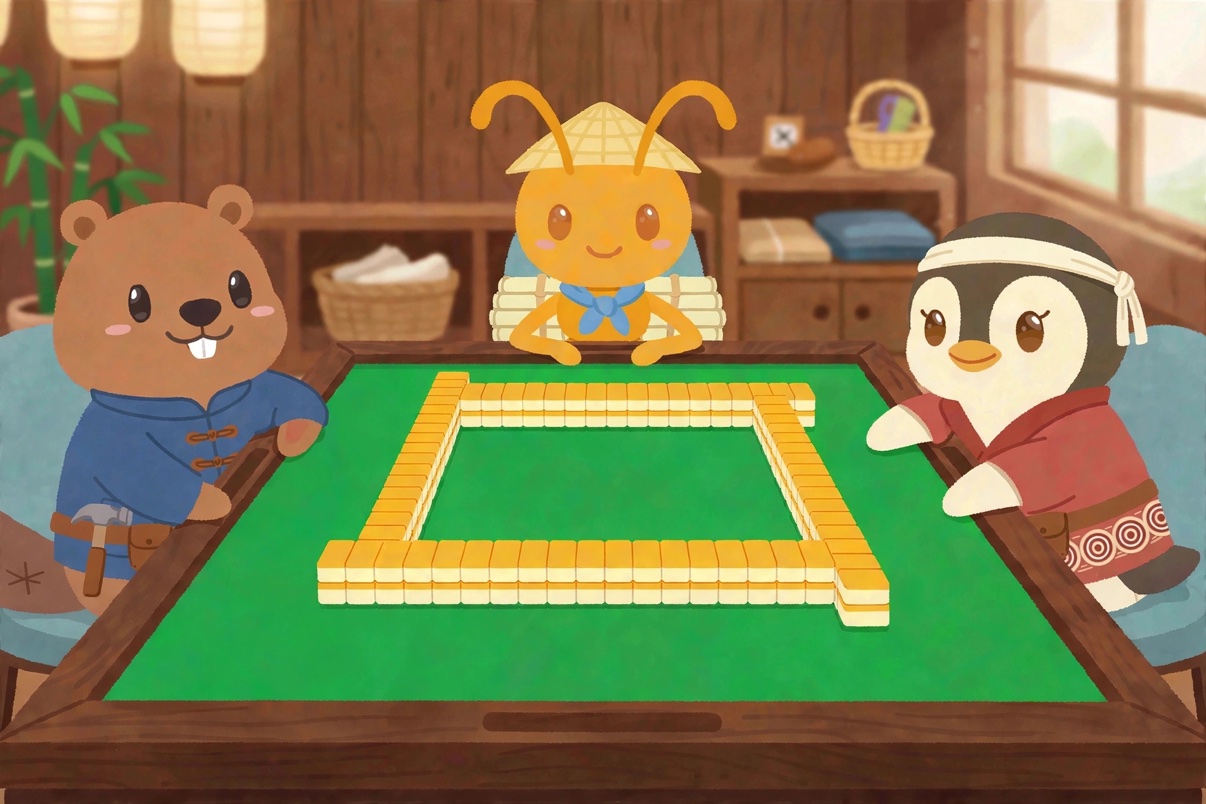
Not the tile-matching solitaire game — in real mahjong, matched tiles are kept and built with, and the tiles you don't need are discarded for someone else to claim.
- 1 Name the tiles
- 2 Finish the set
- 3 Build a hand
- 4 One away!
- 5 Draw & discard
Choose a game
Tap a card to enter game mode. Every game is broken into three levels — Easy, Tricky and Expert — and every set has 14 puzzles, one for every tile in a winning hand. The puzzles are generated fresh from the rules of the game every time you play, so no two sets are ever the same. They really teach mahjong.
Step 1 · Know your tiles
Every mahjong teacher starts here — tiles before anything else. The set has three number suits (Characters, Bamboo, Circles), four Winds, and three Dragons — 34 kinds of tile, four copies of each, 136 tiles in all. These are the very same tiles used in Mahjong Mafia. Instructors aim for a learner who can name any tile in about ten seconds.
Step 2 · Sets are the building blocks
A hand is made of sets plus one pair. A triplet is 3 of a kind, a kong is 4 of a kind, and a sequence is a run of 3 in the same suit, like 4-5-6. Runs can grow from either end — unless they're stuck at the edge.
Step 3 · Build a whole hand — a small one
Real kids' sets never start with 14 tiles. Some teachers start at 8 tiles, others at 5, and the hand grows as the child does. Here you build from a face-up pool — no opponents, no timer — and the hand grows from 5 → 8 → 11 → 14 tiles, with Winds and Dragons joining the later levels.

The pool — tap a tile to take it
Your hand (0 tiles)
Step 4 · Feel the “one away!” moment
The most exciting moment in mahjong is being one tile from winning — players call that hand ready. Good players can name every tile that would finish their hand. Some hands are waiting on just one tile; open-ended runs are waiting on two.
Your hand — one tile from Mahjong
Step 5 · Take a real turn: draw one, throw one
Every turn is the same simple loop: draw a tile from the wall, then throw one away. And if the tile you draw completes your hand, you call “Mahjong!” and win on the spot.
How the hand grows
Every successful kids' program does the same thing: shrink the hand, keep the real tiles and real moves — sort, build sets, draw, discard. Nobody starts a child on the full 14-tile game.
For grown-ups: what the research says
This page is built from research into how children and beginners are actually taught mahjong (researched October 18, 2026). Here's the short version, with sources.
The gap these games fill
Search for “mahjong for kids” and you get almost entirely mahjong solitaire — the tile-matching puzzle. The lesson apps that teach real mahjong (like Mahjong Soul for Riichi) are built for adults. A dedicated kids' app for the real game was not found in app-store and web searches on October 18, 2026 — reported as not found, not proven non-existent, since store search isn't exhaustive.
Real mahjong ≠ mahjong solitaire
They share only the tiles. Solitaire is a single-player matching puzzle invented on a computer (1981, popularized by Activision's Shanghai and Microsoft's Taipei). Real mahjong is a four-player game of building a hand, claiming discards, and reading opponents. As one explainer puts it: “if Mahjong Solitaire is like doing a crossword, real Mahjong is like playing poker — but with tiles instead of cards.” Solitaire teaches tile-face recognition and nothing about hand building, calling, or defense — so matching appears here only as step one, and matched tiles are kept on a rack and built with.
Which game do these pages teach?
The games on this page teach the Asian game — the Guangdong ruleset from the grown-ups' Mahjong Mafia app, with that app's exact tiles: Characters, Bamboo and Circles 1–9, the four Winds and three Dragons, four copies of each kind (136 tiles). Every turn is draw one tile, throw one away, and a hand is four sets plus a pair (or a special hand like Seven Pairs).
The teaching order instructors agree on
Independent progressions — kids' classic sets and a Riichi teaching method — converge on the same skeleton. The games above follow it:
- Name and sort the tiles — suits first, then Winds and Dragons. Sorting a rack into a fixed order is taught as the core habit that makes pattern-spotting possible.
- Match pairs, then make one set — triplet first, then sequence, kong last (“a super-sized triplet,” reserved for later).
- Build a small complete hand from a face-up pool — 5 tiles, then 8 — with no opponents and no timer.
- Draw and discard to finish a hand; play face-up (open) hands so an adult can coach in the moment.
- Grow the hand — 10, 12, then the full 14 — and aim at one pictured target pattern at a time.
- Real turns: draw and discard — each turn you draw from the wall and throw one tile away.
- Calling a discard last, then concealed hands and special hands like Seven Pairs, and only then strategy and defense.
Two cautions from instructors shape the design: don't teach a rule before it can actually come up (early games are built so un-taught situations can't arise), and don't teach a “fake” win condition you'll later revoke. One documented shrinking trick worth stealing: the Riichi method starts with two suits only and an 8-tile hand built from a face-up pool, adds honors, and adds the third suit last.
Session length and difficulty
- Short rounds, one new idea at a time. A common rule of thumb for sustained attention on structured tasks is 2–3 minutes per year of age — roughly 8–12 minutes at age 4, up to 16–24 minutes at 7–8. Adult mahjong pedagogy lands in the same place: short daily sessions of about 10 minutes on one drill.
- Screen time: AAP guidance, summarized by KidsHealth, is up to 1 hour per day of high-quality programming for ages 2–5, with co-viewing encouraged.
- Ramp one variable at a time — hand size, tile pool, target specificity, visibility, assistance, opposition — never two at once. Scaffolding means the help is temporary: show it, do it together, then let the child do it alone, with hints that fade rather than difficulty that only climbs.
Real products that teach kids mahjong
List prices as seen on October 18, 2026; they vary by edition and retailer.
| Product | Ages | Style | How it shrinks the game | Price |
|---|---|---|---|---|
| Mahjong Together (Bo & Mei) | 3–103 | Chinese (closest to Hong Kong) | 5 levels: matching and memory first, then set-building with progressively more tiles, then full classic play. Wooden tiles sized for small hands; the full 144-tile set bridges to real rules. | $120 |
Open questions
- No source gives a validated minimum age for real mahjong. Products start tile play at 3 (Bo & Mei). For 4–5-year-olds the sources support sorting, matching, and Go Fish-style naming games; small-hand play fits 6–8. Nothing specifically validates a progression for 4-year-olds.
- Attention-span figures are practitioner rule-of-thumb ranges repeated across child-development sites, not a single peer-reviewed norm — good design guidance, not a clinical claim.
Sources
- Bo & Mei — How to Play Mahjong with Kids
- Bo & Mei — Mahjong Together product
- Queen City Riichi — Riichi Teaching Method
- Reach Mahjong of New York — Mahjong Drills
- Dear Asia — Mahjong Solitaire Isn't Mahjong
- Mahjong School — 8-stage Riichi curriculum
- KidsHealth — Screen Time for Preschoolers (AAP guidance)